
Story Created: Apr 30, 2011 at 11:54 PM ECT
Story Updated: Apr 30, 2011 at 11:54 PM ECT
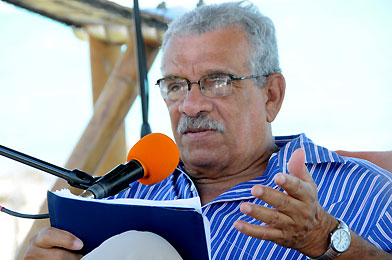
Nobel Laureate Derek Walcott takes 2011 OCM Bocas Prize for Caribbean Literature.
White Egrets, his collection of poetry that has already won the TS Eliot Prize and was judged the winner of the OCM Bocas Prize poetry category, was chosen for the US$10,000 award last night, seeing off competition from the fiction and non-fiction winners.
The judges in their citation commented upon the "seemingly effortless flow of the language and imagery despite the poet's stated premonitions of the loss of poetic power and inspiration…. Walcott is still writing great poetry, lovely cadences, beautiful images".
They considered the book-length poem that is divided into separate poems and is an exploration of bereavement and grief in one's advanced years to be, "a book that tells of a period of life more usually talked at and talked about than heard from or listened to, which makes it a very important work".
White Egrets is Walcott's 14th book of poems. He has also published eight collections of plays and a book of essays. Extracts of the winning collection were featured in two parts in the Express in April.
The poet, who is at work in Europe on a new theatre production, was not present at the award ceremony and his daughter Mrs Elizabeth Walcott-Hackshaw, who is also a writer, accepted the OCM Bocas Prize cheque and trophy on his behalf. Tiphanie Yanique, whose debut novel, How To Escape From a Leper Colony, won the Fiction category, is visiting Trinidad for the occasion but Edwidge Danticat, winner of the Non-Fiction category for Create Dangerously: the immigrant artist at work was unable to attend.
The ceremony last night in the Old Fire Station included many of this country's and the region's most accomplished writers. It was one of the highlights of the new annual Bocas Lit Fest that started on Thursday at the National Library in Port of Spain. Readings from the winning books take place today at 4 pm, followed by poetry and music performed by the Freetown Collective and a jazz session by Mike Germain and Destino at 5pm, which bring the four-day Festival to an end.
May 2, 2011
Derek Walcott wins OCM Bocas Prize
April 27, 2011
Deutsche Börse prize for photography goes to chronicler of displaced people

Magnum photographer Jim Goldberg has documented refugees and immigrants in across the world since 1983.
Jim Goldberg has won this year's £30,000 Deutsche Börse prize for photography, in a ceremony hosted by the Photographers' Gallery in London.
The Magnum photographer, who has documented the experiences of refugees, immigrants and displaced people from Africa, the Middle East and eastern Europe since 1983 in a project titled Open See, triumphed over a shortlist that included fine art photographer Thomas Demand, whom many insiders considered the favourite. Goldberg, who lives in San Francisco, and won the 2007 Cartier- Bresson Prize for an earlier version of the same project, describes himself as a documentary storyteller.
Open See was shown to great acclaim at the Photographers' Gallery last year. It features polaroids, video stills, found images and hand-written text often using the words of his subjects.
The chair of the jury, Brett Rogers, praised Goldberg's "timely and inventive approach to documentary practice … allowing these individuals to tell their own stories."
See link here.
Regional heads worry about Libyan investments

By KINGSTON
Story Created: Apr 25, 2011 at 11:48 PM ECT
Story Updated: Apr 25, 2011 at 11:48 PM ECT
For the Caribbean governments, particularly those in the sub-regional Organisation of Eastern Caribbean States (OECS), the events unfolding in Libya are more than just an attempt to remove an African leader from power.
For the nine-member OECS grouping who have adopted their own lines of engagement with Libya, much to the concern of some opposition parties, their main concern is—what will become of Libyan investment projects in region?
"Whether we like it or not, we're still very much dependent on oil from the Middle East and most of our economies are driven by that," said Prime Minister Baldwin Spencer of Antigua and Barbuda.
In the midst of the unrest in Libya, leaders in the region have found themselves caught between the proverbial 'rock and a hard place'.
Many of St Vincent and the Grenadines' major development projects in recent years have benefited from Libyan funding. The opposition in St Vincent and the Grenadines has criticised Prime Minister Ralph Gonsalves' government for accepting what opposition leader Arnhim Eustace describes as "blood money".
Read full article here.
Beenie warns immigration

BY YVETTE BEST | WED, APRIL 27, 2011 - 12:03 AM
BARBADOS NATION NEWS
DANCEHALL KING BEENIE MAN has a timely word of advice for the local immigration authorities.
He took a moment from his performance before a massive crowd at Brandons Beach, St Michael, for the Reggae Beach Party last Sunday night, to speak to the ongoing issue with his countrymen and local officials.
“Ease up Jamaican. Stop pressure Jamaican,” he said from the stage as he wagged his finger.
Speaking to the DAILY NATION after his explosive performance, Beenie said it was a warning, not a threat.
“Sometime you get fed up ah one ting, yuh know. ’Cause you have been all over de world and den sometime you doan really need to come to Barbados.
The immigration need to tink twice. I ‘ave friends who come over ‘ere and end up in jail fi four days fi no reason,” he stated.
He said he too had been “arrested” by local officers. He said he had issues on his last visit, but everything was cool this time around. Having said that, Beenie Man said the “vibes nice and de people dem enjoy demself and me like that. Thank you Barbados”.
Reports about Jamaicans being ill-treated have recently come into focus in the wake of accusations by Shanique Myrie that she was finger-raped while being held in Barbados last month.
Beenie said he had performed here a total of 15 times since 1992, and kept coming back because of the people.
The live wire on stage said he had been busy touring and was currently working on a new album, titled The King In Control, which is due out this summer.
PM: Cameras coming at all ports

BY MIKE KING | WED, APRIL 27, 2011 - 12:05 AM
SHANIQUE Myrie is free to return to Barbados and point a finger at who she alleges assaulted her at the Grantley Adams International Airport last month.
And according to Prime Minister Freundel Stuart, surveillance cameras will be installed to confirm or contradict any allegation in the future.
This country’s seventh Prime Minister made these disclosures on a nationally televised interview on the state-run Caribbean Broadcasting Corporation (CBC TV) last night.
Prime Minister Stuart said the Myrie affair in which the Jamaican woman claimed she was finger-raped at the airport was unfortunate and had inflamed many passions. However, he said he was disappointed that certain elements had tried to inflame the issue because they thought that “here at last was a stick in which Government could be beaten”.
Stuart said he had in his possession a full report by the police on the issue, statements from all of the persons who were involved and gave the country the assurance that his Government was on top of the matter.“
No obstacles will be put in the way of Miss Myrie if she wants to be come back to Barbados and to point out to police who the offending officer, as alleged by her, might be.
“Suffice to say, I am not aware that there has been any formal complaint from the Jamaican police to the police authorities that would activate any prosecutorial processes,” he said.
Stuart said that relations between Barbados and all of its regional neighbours would continue to be normal.
The Prime Minister said there was a view that if any cameras had been in place for the March 14 incident, there might not have been any scope for speculation.
Read full article here.
April 26, 2011
Jamaica could take Shanique Myrie case to CCJ
Dr Kenneth Baugh, minister of foreign affairs and foreign trade, has warned that the CCJ could be asked to rule on the case if the two countries cannot work out their differences.
This would be the first time that the Jamaican Government would be taking a case to the CCJ since it was established in 2001.
Ironically, the Jamaica Labour Party (JLP), which now forms the government, has been opposed to the CCJ being the country’s final court of appeal, although in recent months there has appeared to be a softening of that position inside the party.
With the Myrie dispute now at the level of government to government and a probe under way in Bridgetown, the Jamaican authorities are demanding that the Barbadian government does all that is necessary to establish the facts.
The dispute stems from claims by Myrie that she was subjected to verbal harassment and a demeaning cavity search on arrival in Bridgetown.
Responding to questions from Opposition Spokesman Anthony Hylton during last week’s meeting of the Standing Finance Committee of Parliament, Baugh declared that Jamaica is not backing down on the Myrie case.
Read full article here.
Myrie case triggers reminders
BY TONY BEST | FRI, APRIL 15, 2011 - 10:00 AM
Names such as Tawana Brawley, Maryam Muhammad, Steven Pagones, Alton Maddox, C. Vernon Mason and Henry Crist are unlikely to ring many bells in Barbados or Jamaica.
But to a criminal investigator in New York City, they mean quite a lot. As a young lawyer in the late 1980s he followed an unfolding drama that involved those names and attracted national and international attention.
Twenty-four years later, he isn’t quite sure who or what to believe, except that he is leaning to accept the findings of a special grand jury that looked into the high-profile case.
Hence, when emotions ran high in Jamaica and Barbados after Shanique Myrie levelled explosive charges that she was “finger-raped” by a female immigration officer at Grantley Adams International Airport and Barbados’ Foreign Minister, Senator Maxine McLean, rejected the charges as being “baseless,” the attorney offered a word of caution to both sides.
“I believe Barbadians and Jamaicans should let investigators do their work, carefully and independently,” said the man who requested anonymity because of the position he holds in the city.
“The Tawana Brawley case offers a poignant reminder about how things can go horribly wrong and how passions can be inflamed when we rush to judgement.”
Read full story here.
April 25, 2011
Danticat documents truths about Haiti for the world to see

In documenting painful truths about her Haitian homeland, Miami writer Edwidge Danticat demands that the world not turn a blind eye, writes Lydia Martin, who interviewed Danticat for the Miami Herald in the wake of the renewal of U. S. deportations of Haitians.
Music blares on a hectic Friday afternoon at Buena Vista Bistro, Edwidge Danticat’s favorite lunch spot, just a quick stroll from her house on the edge of Little Haiti. Patrons bellow in that wound-up, weekend’s-here way, and stressed-out servers do a valiant job of avoiding eye contact.
You’ve been sitting here 20 minutes, and no one has brought even water. But Danticat, who spent the morning wrestling with a deadline for one more op-ed piece about Haiti and will have to run soon to pick up Mira and Leila, her young daughters, is unperturbed.
“After the earthquake, we went a year without deportations,’’ she says, explaining in her unhurried, even way the topic of the piece she just finished for The New York Times as the low pitch of her voice pulls you in and mutes the clanking and clamoring around you.
“But then the deportations started again. A South Florida man died of cholera when he was sent back. It’s just inhumane. Many of the people who are sent back don’t have criminal records. It’s as if you were deporting people to Japan right now. It’s almost like a death sentence. A study says that 800,000 people could get cholera in Haiti this year once the rainy season starts. I just want to get the word out.”
For Danticat, Haiti has always weighed heavy. At 12, she moved from her homeland to join her parents, who had left her in Port-au-Prince in the care of an aunt and uncle a few years earlier to find jobs in New York that helped support several folks back home.
Read full article here.
April 18, 2011
USA resumes deportations to Haiti - is this a death sentence for returnees?
MONDAY, APRIL 18, 2011 www.Nationnews.com
WASHINGTON – Despite what has been described as a humanitarian crisis, the United States has started the second round of deportations to Haiti.
Immigration officials said that 19 Haitians, who had been convicted of crimes in the US, were sent back to the impoverished, French-speaking Caribbean country.
“US officials confirmed that they have received no assurances that the 19 individuals who were deported will be treated humanely upon their arrival in Haiti,” said the Washington-based Center for Constitutional Rights, a civil rights advocacy group, after a conference call with immigration officials.
Friday’s deportation was the second since the devastating January 12 earthquake in Haiti last year that killed an estimated 300,000 people and left more than a million others homeless.
The US had halted deportations in the wake of the massive earthquake, but immigration officials announced in December that would resume deportations in January.
At least 27 Haitians were deported on January 20.
Immigration and Customs Enforcement (ICE) officials said they plan to send 700 immigrants back to Haiti this year, ignoring the objections of human rights groups, which insist that the move is “equivalent to a death sentence.”
Barbara Gonzalez, an ICE spokeswoman, said those sent back were “criminal aliens,” who were convicted in US courts for various violations of the law. She said all have already served sentences in American prisons.
The Center for Constitutional Rights and a number of immigration advocacy groups have condemned the latest round of deportations, calling on the Obama Administration to immediately “halt all removals to Haiti and the release of all Haitians being held with final orders of removal.
“The United States has an obligation not to deport anyone to death,” said the groups, which comprise the University of Miami School of Law Human Rights Clinic and Immigration Clinic, FANM/Haitian Women of Miami, Alternative Chance, and Florida Immigrant Advocacy Center.
“Our country must live up to its human rights commitments and immediately halt any and all deportations to Haiti,” they added. (CMC)
April 15, 2011
OUR CARIBBEAN: Health care in Caricom
BY RICKEY SINGH | FRI, APRIL 15, 2011 - 12:00 AM
When Caribbean Community Health Ministers assemble in Guyana today for a two-day meeting, they will have the opportunity to face an issue of deepening concern to the region’s people.
It has to do with a recognised need for a region-wide common approach for non-nationals with legal status to access prescribed drugs and health care benefits – without discrimination.
This problem has been made all the more urgent for objective consideration as a result of cries against discriminatory practices being experienced by non-nationals, with Barbados referenced as a current example for its exclusion of CARICOM nationals from access to even free drugs they once received – unless they have citizenship or “permanent residence” status.
This weekend’s 21st meeting of CARICOM’s Council for Human and Social Development (COSHOD), will have a special focus on “pressing issues related to the region’s health sector development and sustainability”, according to the Community Secretariat, with the battle against chronic non-communicable diseases (NCDs) being a major topic for consideration.
Current chairman of COSHOD, Guyana’s Health Minister Dr Leslie Ramsammy, who will chair the meeting, has said it would be difficult to “mobilise much needed active cooperation of nationals of CARICOM in the fight against NCDs – which remains a major and costly headache for our Community, if we do not strive together to achieve a common policy for our nationals to access free medical benefits, wherever possible and without feeling they are being discriminated against as a consequence of either official policy or practices . . . .”
His idea would meet with the approval of St Kitts and Nevis Prime Minister Dr Denzil Douglas, who has lead responsibility in CARICOM for health and human resources development Douglas wants to see the Community “prioritise an enlightened common approach in the provision of health care for all nationals of our Community . . . .”
Read full article here.
Visas for Jamaicans, Guyanese in effect, but confusion abound

PHILIPSBURG--Nationals of Jamaica and Guyana now require a visa to visit St. Maarten. The requirement went into immediate effect on Monday, April 11 leaving travellers already booked to visit the country in the coming days in limbo because no easing in period was given.
Justice Minister Roland Duncan confirmed that visas were now needed, in a press release issued after The Daily Herald contacted his office asking for clarity because the Dutch Consulate in St. Kitts and Nevis had sent out a fax on Monday morning to travel agents in countries under its scope, but nothing had been issued locally by government.
Government had taken the decision to put a visa requirement in place for nationals of the two countries in a bid to curb the influx of undocumented persons and crime. That decision of the Council of Ministers was sent on to the Dutch Ministry of Foreign Affairs.
While the press release from Duncan and the fax from the Dutch Consulate in St. Kitts and Nevis that was obtained by this newspaper states that the visa requirement was in immediate effective, travellers in Guyana who contacted Dutch authorities there were told that an official enforcement date still had to be set. This meant that travellers already booked can still travel without a visa until the yet-to-be decided enforcement date.
The Dutch Consul in Guyana directed callers to a contact person at John Fernandes Limited who explained that forms for visa application could be obtained at the office when requirement was enforced.
Attempts to get further clarification on the state of affairs from the Justice Ministry proved futile. Personnel at the ministry were not even aware that the visa requirement had come into effect on Monday and were provided with a copy of the fax obtained by this newspaper.
Read full article here.
April 13, 2011
Is Myrie a Caribbean version of Rosa Parks?
BY TENNYSON JOSEPH | TUE, APRIL 12, 2011 - 12:01 AM
While social scientists tend to place heavy emphasis on large structural and economic explanations for occurrences of historical significance, the reality is often that the catalysts for these developments are often unassuming, ordinary individuals who refuse to stand at the back of the bus.
In the case of Rosa Parks, it was not a radical historical consciousness, but her overworked tired feet which compelled her to break the racist Jim Crow laws which were in operation in the southern United States at the time.
In our own time, we have seen how Mohammed Bouazizi, the Tunisian man who set himself ablaze, simultaneously set alight a wave of anti-authoritarian protests and revolutions throughout the Middle East and North Africa, far beyond what he was thinking when he made a human torch of himself. (What really was he thinking anyway?)
Marx describes this dynamic between individual action and structural change best, with his famous reminder that “whilst men make history, they do not make it in conditions of their own choosing”.
These historical realities therefore compel pro-integrationist Caribbean people to find a silver lining in Shanique Myrie’s refusal to remain silent in the face of what she regarded as unjust violations of her personal space, whilst seeking to move across her Caribbean.
Read full article here.
April 11, 2011
Barbados again! - Another J'can woman says she was mistreated Read more: http://www.jamaicaobserver.com/news/Barbados-again--Another-Jcan-woman-says-

YET another Jamaican woman has come forward with accusations of mistreatment by the authorities at the Grantley Adams International Airport in Bridgetown, Barbados.
Although Donna Benjamin-McLean's alleged case of abuse occurred in September 2004, she has decided to come public in solidarity with Shanique Myrie — a Jamaican woman who has bitterly complained of being strip searched, finger-raped, verbally abused and locked up before being shipped out of Barbados without a reasonable explanation.
In an interview with the Observer on Saturday, Benjamin-McLean expressed her displeasure with reported denials by Barbadian authorities that Myrie's account was lacking in veracity and that she was a victim of human trafficking.
"I want Barbados to know that it is happening. They are behaving as if it never happened, as if it is a lie. I don't believe I will ever revisit Barbados, because I fear them," Benjamin-McLean said.
Benjamin-McLean said she was plucked from the immigration line upon her arrival in the eastern Caribbean island and subjected to demeaning treatment after she was accused of smuggling drugs.
"They had my luggage on the counter all opened, they searched and found nothing. Then two women took me into a room and said I should strip. I took my clothes off, leaving my panties and they said 'take the panty off'. So I said, 'I can't because I am seeing my menstruation' and they said 'drop off the pad'â so I dropped it off," a distraught Benjamin-McLean said.
She also said that the Barbadian authorities put her through even further humiliation.
Read more here.
Jailed and raped in Barbados

Jailed and raped in Barbados
Horrific allegations of another J'can woman
BY KARYL WALKER
Sunday, April 10, 2011
THE 27-year-old Jamaican woman who has accused officers of the Royal Barbados Police Force of rape and sexual assault has given a graphic and horrific account of the treatment she said was meted out to her after she was jailed in that country two months ago for drug smuggling.
The Sunday Observer obtained a copy of her signed statement, in which the woman, whose name we have been asked not to reveal, described the men she accused of the crime.
According to the woman, who lives in Spanish Town, she arrived at the Grantley Adams International Airport in Barbados on a Caribbean Airlines flight from Jamaica on Saturday, February 26. She cleared immigration, but was stopped by customs officials who searched her bag and found approximately two kilos of ganja hidden in a secret compartment.
She was strip-searched and taken to the Oistins Police Station where officers took a statement from her, but denied her the opportunity to make a phone call. They also denied her the opportunity to seek legal counsel, she said, and mocked her by saying that no lawyer would take her case because she had no money.
Later that night, she was transferred to the Central Police Station in Bridgetown, where she again gave a statement. She was then placed in a cell where, over the course of the next day, she alleged, she was raped, sexually assaulted and verbally abused by police officers.
According to the woman, after being locked in the cell, she heard a man call her name. The man, who she said was dressed in a plaid shirt and a pair of jeans, questioned her about her life in Jamaica, verbally taunted her, forced her to take a tablet he gave to her after which he demanded sex.
“When I took the tablet I felt like I was floating. I felt reckless and tired, but I was conscious of what was going on around me,” she said.
“He asked me if I didn’t want to have sex and I said ‘Sex? Sex a di least a my problems right now. Sex a di last thing pon my mind’. He said I had to have some sex with him before I go to Dodds (prison), so I started to cry,” she said.
Read more here.
April 2, 2011
Bajans Living Overseas sent home an estimated $322 Million last year
Check out PP 2/3 of the Barbados Today April 2nd edition to learn more about Bajans emigration.
http://edition.pagesuite-professional.co.uk/launch.aspx?referral=other&refresh=nB03X2t11K6g&PBID=87ad6005-1972-4d63-92b0-8927eda53c7a&skip=
March 30, 2011
McClean’s words ‘reckless’
BY TIM SLINGER | WED, MARCH 30, 2011 - 12:03 AM
MINISTER OF FOREIGN AFFAIRS and Foreign Trade Senator Maxine McClean has come under fire for her handling of the incident involving a 22-year-old Jamaican woman, who claimed she was finger-searched before being denied entry into Barbados two weekends ago.
Jamaica’s Public Defender Earl Witter described McClean’s remarks that Shanique Myrie’s claims were baseless and untrue as injurious and reckless, adding that it had contributed significantly to the deteriorating relations between the two countries.
“I consider [McClean’s] remarks were injurious when she pronounced Myrie’s allegations a total fabrication. [McClean] was making definitive judgement as was reported to her by Barbadian functionaries.
“[McClean] should have heard evidence of both sides before making judgement that Myrie’s story was a fabrication,” Witter told the DAILY NATION from his office in Kingston yesterday.
Noting he sensed “a motion of hostility” while McClean was issuing her statement on the issue, Witter said she was also contemptuous when she referred to a diplomatic note sent from Jamaica to the Barbados Government as a “piece of correspondence”.“It smacks of contempt and to label it (diplomatic note) that way is to demean diplomatic correspondence at the highest level.
“It disturbs me,” he added.
Witter, who has been mandated by the Jamaican government to look into the matter, said he had made a request to Ombudsman Valton Bend to independently investigate the matter and report his findings.
But he noted that might not now be possible since Bend might find himself in an awkward position, given the stance of the Minister of Foreign Affairs.
Witter said that based on the current atmosphere the incident had triggered, the court could be the best recourse to settle the issue.
“I don’t think it can be resolved in any other way. All the alleged actors can be subjected to cross-examination.
“The relations between the two countries are in a very unhappy state,” he added.
Barbados could be hauled before the International Court of Human Rights

BY SANKA PRICE | WED, MARCH 30, 2011 - 12:04 AM
THE BARBADOS Government will be hauled before the International Court of Human Rights, if need be, to ensure Jamaican Shanique Myrie gets justice for the trauma she reportedly suffered at the hands of airport officials.
Myrie’s attorney, Anthony Hylton, pledged this yesterday saying he wanted to ensure she was vindicated in her claims of being finger-raped on March 14 after her arrival at the Grantley Adams International Airport before being denied entry.
“It did happen, and we will prove it,” said Hylton, a former Jamaican minister of foreign affairs. “We know the hurdles in the law and we will get around it.
“We are aware that the police are who did it,” he said in a telephone interview from his New Kingston office.
He, however, declined to speak further on this accusation. Myrie had said she was cavity searched by a female immigration officer.
When the MIDWEEK NATION reached Myrie yesterday, she referred questions to her attorney.The glum sounding 23-year-old did say: “I am very depressed at the moment.”
The issue is expected to be raised today at a meeting of the Caribbean Community Council.
Read full article here.
March 29, 2011
Jamaican delegation to head to Barbados this week

The Foreign Affairs ministry says a high level delegation is to travel to Barbados this week to have discussions with officials in that country regarding allegations of abuse of a Jamaican at an airport there.
There has been much public outcry since Shanique Myrie, reported that on a visit to Barbados on March 14 she was subjected to two demeaning cavity searches by a female immigration officer and was detained for hours for interrogation.
She also said the immigration officer made several derogatory remarks about Jamaicans.
The Ministry says it has sought to address her case through diplomatic channels but has received no response to a diplomatic note faxed on March 25.
However, it says Foreign Affairs Minister, Dr. Ken Baugh, received an email from his Barbadian colleague outlining the text of a press release from the Barbados Government Information Service on March 26.
The report has refuted Myrie’s claim of abuse.
The Foreign affairs minister also received information showing that for the three-year period from 2008 to 2010 about 851 of the more than 51,000 Jamaicans who sought to enter Barbados were denied entry.
Read full article here.
Jamaica group to study airport abuse claims
TUE, MARCH 29, 2011 - 12:06 AM The Barbados Nation News
The Jamaica Association is still to take a position on reports that a Jamaican woman was verbally and sexually abused at the Grantley Adams International Airport.
President Peter Kerr told the DAILY NATION yesterday that the association had not yet come to a position on the matter, but Jamaicans were “feeling aggrieved” at reports of an inappropriate search by Immigration officials of Shanique Myrie on March 14.
He said the association would be looking to obtain from the various parties involved reports that would be reviewed at an upcoming executive meeting.
The association’s executive would make a determination on whether there was need to get the general membership involved in the matter, he reported.
Ever since the story broke in the Jamaica Observer newspaper, people have been airing views in the Press and the other media.
Authorities launched an investigation into the matter and last Saturday Minister of Foreign Affairs and Foreign Trade Senator Maxine McClean told the Press there was no truth to the allegations.
McClean made it “absolutely clear that a thorough investigation had been carried out by the Immigration and Customs departments into reports that had been carried in the Jamaican Press suggesting that Shanique Samantha Myrie had been finger-raped by Immigration officers after she arrived on Barbadian soil”.
Following the announcement by McClean, Jamaica’s Foreign Affairs and Foreign Trade Minister Ken Baugh said he would be raising the issue at the impending CARICOM Council meeting in Belize.
Baugh also encouraged Jamaicans to inform the government of any unfair treatment they experienced while overseas.
Jamaica’s National Security Minister Dwight Nelson also expressed strong views on the matter and wrote a letter to Public Defender Earl Witter, urging him to intervene. (YB/TS)
Caricom must deal with free movement

TUE, MARCH 29, 2011 - 11:00 AM
Prominent Caribbean academic and political scientist, Professor Neville Duncan, is calling on Caribbean Community (CARICOM) governments to make a definitive statement on the issue of free movement within the region.
His statement follows the decision of the Jamaica government to take claims of by one of its nationals that she was sexually and verbally abused by Barbadian customs and immigration officials to the meeting of the Caribbean Community (CARICOM) Council meeting this week.
In addition, the National Security Minister, Dwight Nelson, has written to Public Defender, Earl Witter, asking him to intervene in the issue after the woman, Shanquie Myrie, claimed she had been subjected to sexual and verbal abuse at the hands of the authorities at the Grantley Adams International airport last week.
But Parliamentary Secretary in the Prime Minister’s Office, Harry Husbands, who has responsibility for Immigration, said there was no record of Myrie being searched by either immigration or customs officers and that a full statement would be issued after more investigations.
Read full article here.
March 28, 2011
Finger-rape claim untrue

BY CHRIS GOLLOP | SUN, MARCH 27, 2011 - 12:03 AM
THERE IS NO TRUTH to a report by a Jamaican woman who claimed she was finger-searched before being denied entry into Barbados last week.
Government is however planning a high-level meeting with the Jamaican High Commissioner to Trinidad to try to prevent any major fallout between the two countries as a result of the media hype surrounding the incident.
At a Press conference yesterday, Minister of Foreign Affairs and Foreign Trade Senator Maxine McClean made it “absolutely clear that a thorough investigation had been carried out by the Immigration and Customs departments into a report that had been carried in the Jamaican Press suggesting that Shanique Samantha Myrie had been finger-raped by Immigration officers after she arrived on Barbadian soil on March 14”.
The story made headlines in Jamaica, and McClean confirmed to reporters attending the briefing at Government Headquarters that Jamaica’s Minister of Foreign Affairs and Trade Ken Baugh had written to her seeking an urgent investigation into the matter.
After three days of investigations, however, McClean told reporters:“There is absolutely no truth to a story carried in a Jamaican newspaper on Thursday, March 24, that a female citizen of that country was body-searched by Immigration officers on arrival at the Grantley Adams International Airport.”
In a prepared statement, she added: “Chief Immigration Officer Ms Erine Griffith has refuted this allegation made in the Jamaica Observer. She has confirmed that her department and Customs ‘have carried out extensive investigations and the claims were baseless’.”
Read full article here.
Jamaican Myrie plans to sue

SUN, MARCH 27, 2011 - 3:00 PM
Shanique Myrie, the Jamaican woman who complained of being finger-raped and humiliated by Barbados immigration authorities earlier this month, has hit back at claims by the Barbados Government that she was not subjected to a body cavity search.
On Friday, Parliamentary Secretary in the Prime Minister’s office, with responsibility for Immigration, Senator Harry Husbands claimed there was no record of Myrie being searched by either immigration or customs officers and alleged that the Jamaican was a victim of human trafficking.
“Shanique Myrie, on arrival in Barbados, claimed she would have been staying with a female resident, but a closer investigation however revealed she was actually staying with a Barbadian man who actually facilitates the entry of non-nationals into the island,” Husbands was quoted in the online edition of Nation News as saying.
“I am going to sue them,” she said yesterday and contradicted Husbands’ statements.
She insisted that she was “defiled” by the Barbadian authorities at the Grantley Adams International Airport on March 14.
“I am not lying. They humiliated me and searched me like I was an animal. They can carry me back to the Barbados airport and I can show you every room they took me into. I can identify the woman who defiled me. They are the ones who are lying,” she told the Sunday Observer.
In her interview published in the Daily Observer on March 24, Myrie said: “The lady took me into a bathroom and told me to take off my clothes. I did as requested. After searching me and my clothes, she found no contraband or narcotics. She then asked me to bend over, open my legs and spread [my private parts]. She said that if I did not comply then she would see that I end up in prison in Barbados. When I bent over and spread my [private parts] I felt something enter my [private parts] and when I looked between my legs I saw her gloved hand in my [private parts]. I screamed and stood up.
“She then told me if I obstructed her doing a cavity search she would have me locked up. I bent over again and spread. She again inserted her fingers and poked around. I felt like I was being raped. I was so hurt and ashamed. I felt dirty and defiled, I don’t even know if the gloves she used was clean or had been used on somebody else,” she said.
Myrie, who said the immigration officer removed her identification tag before humiliating her, also said the immigration officer expressed her hatred for Jamaicans.
Read full article here.
Taking it to CARICOM!
MON, MARCH 28, 2011 - 12:03 AM
KINGSTON – The Jamaica government says it will take the claims by one of its nationals that she was sexually and verbally abused by Barbadian customs and immigration officials to the meeting of the Caribbean Community (CARICOM) Council meeting this week.
Foreign Affairs and Foreign Trade Minister Dr Ken Baugh says the matter will be raised at the Council meeting, which is CARICOM’s second highest decision-making body.
“This is something that we have discussed . . . It is not necessarily Barbados but in the Caribbean. It’s a very topical issue at all our meetings at COTED (Council for Trade and Economic Development) as well as COFCOR (Council on Foreign and Community Relations), and I’m going to raise this at the Community Council meeting in Belize next week,” said Dr Baugh.
National Security Minister Dwight Nelson on Friday wrote to Public Defender Earl Witter asking him to intervene in the issue after the woman, Shanique Myrie, claimed she had been subjected to sexual and verbal abuse at the hands of the authorities at the Grantley Adams International Airport.
Nelson expressed outrage at the incident, noting that he was awaiting word from Baugh about discussions he was seeking with his Barbadian counterpart.
Baugh said he was encouraging Jamaicans to inform the government of any unfair treatment they experienced while overseas.
“People need to give us the information. They can call the ministry, write a report and send the information to us. I’ve asked my permanent secretary to document all the information so that when I go to the Community Council meeting next week I can give documentary reports,” Baugh added.
Meanwhile, the foreign affairs minister is refuting reports that Marlon Gordon, Jamaican’s honorary consul to Barbados, was removed because of his staunch defence of Jamaicans in Barbados.
A report in Friday’s Jamaica Observer newspaper quoted Gordon as saying that he resigned in January because the Barbados Government was not receptiveto his complaints.
But Baugh, speaking on a radio programme here, said: “That story is not in harmony with what I understand.
“We appointed him to be our honorary consul in Barbados and he was not approved and when we inquired, we learnt the reason why and there were other reasons which I will not go into. I read the article in the Observer and it had nothing to do with that at all. There were other reasons,” he said. (CMC)
March 27, 2011
The Bocas Lit Fest

The Bocas Lit Fest, based in Trinidad and Tobago, is an annual celebration of books, writing, and writers. Launching in April 2011, the Bocas Lit Fest is an exciting new addition to the Caribbean’s literary calendar. The centrepiece of the festival will be the award ceremony for the OCM Bocas Prize for Caribbean Literature, a major new award for Caribbean writers of poetry, fiction, and literary non-fiction.
Boca is the Spanish word for mouth — the organ of speech and song and storytelling. And the Bocas del Dragón — the Dragon’s Mouths — are the narrow straits off Trinidad’s northwest peninsula, which connect the sheltered Gulf of Paria to the open Caribbean Sea. For centuries, the Bocas were the gateways connecting Trinidad to the Caribbean and the Atlantic. The Bocas Lit Fest invites readers from around the world to enter through the Dragon’s Mouths and celebrate with us the rich literary heritage of Trinidad and Tobago and the wider Caribbean.
The OCM Bocas Debate: first in an annual series of a high-level discussions of burning public-interest topics. This year’s subject: “Press vs. Government: the freedom to print what?”
Visit the official website for the full schedule at: http://www.bocaslitfest.com/schedule.html
BBC Caribbean Service makes final broadcast

The BBC Caribbean Service has made its final broadcast, ending seven decades of programming for the region.
The service is being shut as part of budget cuts announced by the BBC World Service in January.
BBC managers say they have had to make tough choices because of a 16% cut in UK government funding.
But one critic called it a short-sighted decision, showing the BBC did not understand the complexities of the region.
The Macedonian, Albanian, Serbian and Portuguese for Africa services have also been closed in a bid to to save $75m (£46m) a year.
Seven other language services have moved away from radio to focus on online, mobile and television content.
These include Spanish for Latin America which last month ended its remaining radio broadcasts, on short-wave and intended mainly for Cuba.
This week, members of the Caribbean Service team have each presented a final programme, including material from the BBC archives.
Copies of the sound and text content of the service's radio and online output are being donated to the University of the West Indies, which will have a team working at the BBC's Bush House base to catalogue the material.
Regional voice?
E-mails to the Caribbean Service overwhelmingly voiced sadness at its closure.
"It filled a great need for the Caribbean audience to have a view of the world not provided by local radio stations," wrote Jacqueline Sharpe in Trinidad and Tobago.
Regional media commentators have said the demise of the BBC Caribbean Service should spur renewed efforts to create a pan-Caribbean news network.
Read full article here.
March 24, 2011
Jamaicans abused at Barbados airport
Several Jamaicans who were recently denied entry into Barbados in separate incidents are furious with Barbadian immigration officers after they said they were discriminated against, sexually violated, assaulted, detained, and denied entry for the sole reason that they are Jamaicans.
The complainants also say they were labelled as drug mules as the immigration officers reportedly stereotyped all Jamaicans as being involved in drug trafficking.
One woman, Shanique Myrie, recounted her horror to THE STAR which took place last Monday.
"All you Jamaicans come here to do is either steal people's man or bring drugs here," Myrie said she was told by an immigration officer.
She added that after she arrived in Barbados she told immigration officers that her purpose for visiting was to stay with a friend who she met over the Internet but they did not believe her.
She said that she was immediately escorted to a room where she was questioned by two unidentified persons who continued to accuse her of lying about her reasons for visiting Barbados.
Interestingly, she emphasised that even after she gave them all the contact details for the person she was visiting and her story was verified, immigration officers continued to intimidate her, accused her of being a liar and began degrading all Jamaicans.
strip searched
She said that her luggage was searched for contraband and even when nothing illegal was found, the intimidation continued.
According to Myrie, at one stage she was escorted into a room, where the unidentified man returned with her passport in his hand, showing her that she was cleared to enter Barbados but her entry would be cancelled if she did not tell them the truth.
She maintained her innocence and was then escorted to the bathroom area where she was strip searched, "I felt like I was being raped," Myrie recounted.
Myrie said she was then returned to the room and it was then that the female immigration officer who searched her allegedly told Myrie that, "You are a liar, I don't like you Jamaicans, you are all liars. You think you're going to come here and (mess) up my country. It's not going to happen."
Myrie said she later asked if she could make a call to Jamaica to inform her family of what was taking place, but she was not allowed to do so.
Afterwards, Myrie said she asked if she could contact the Jamaican High Commission but was told by another immigration officer that, "If you know what is good for you, you will shut your mouth,".
Read full article here.
Finger-raped in Barbados

ALLEGATIONS by a Jamaican woman that she was finger-raped by an immigration officer before being thrown out of Barbados, have brought the spotlight on poor treatment of Jamaicans visiting that eastern Caribbean island.
Shanique Myrie complained bitterly to the Observer yesterday that when she attempted to enter Barbados on March 14, 2011, she was subjected to two demeaning cavity searches by a female immigration officer who continuously spewed venom about Jamaicans. It was her first trip out of the island.
Myrie's story was corroborated by former Jamaican honorary consul to Barbados, Marlon Gordon.
Gordon, an attorney, said even though some Jamaicans do enter Barbados and get involved in nefarious activities, that was no excuse for wholesale discrimination against Jamaica nationals.
"This arbitrary kind of behaviour that is being exhibited by the Government in Barbados has to be looked at. You can't penalise an entire nation," Gordon said.
Jamaican Jaydene Thomas, a former journalist and now a practising attorney in Barbados, said the Jamaican foreign ministry had for too long ignored the cries of Jamaicans who suffered at the hands of Barbadians when they visited that island.
"Every time that a flight arrives from Jamaica, the nothing-to-declare line is automatically closed, she said. "We are treated like criminals by the authorities."
Myrie, in relating her story to the Observer said: "The lady took me into a bathroom and told me to take off my clothes. I did as requested. After searching me and my clothes she found no contraband or narcotics. She then asked me to bend over, open my legs and spread (my private parts). She said that if I did not comply then she would see that I end up in prison in Barbados.
Read full article here.
Read more: http://www.jamaicaobserver.com/news/Finger-raped-in-Barbados_8573453#ixzz1HZX5AQAX
Tighter rules for UK student visas
By Sean Coughlan
BBC News education correspondent
Theresa May: "We will toughen up the entry requirements"
The rules for student visas into the UK are to be much tougher - after fears that this route of entry is being used dishonestly.
Home Secretary Theresa May said student visas were being abused and "too many were here to work and not to study".
She announced plans to cut the number of student visas by up to 80,000 - about a quarter of the current numbers.
Shadow home secretary Yvette Cooper warned that rules must not damage an industry worth £5bn a year.
Mrs May told the House of Commons that the misuse of student visas had become a "symbol of a broken and abused immigration system".
Language rules
Tightening rules to stop false applications would be "in the best interests of legitimate students," she said.
The tougher rules will include a requirement for students to be able to speak English.
Mrs May said she wanted to end the situation where would-be students arrived at UK airports unable to even describe the courses they were about to begin.
There will also be tighter regulations on allowing the dependents of students to join them in the UK - and less flexibility in the number of years that overseas students can spend in the UK after courses are finished.
In response to concerns that students visas are being misused by economic migrants, there will be limits on the hours of paid work which overseas students will be allowed to carry out.
Universities had previously expressed fears about the loss of overseas students from tighter visa rules - but Universities UK said that their concerns had been taken into account.
Students at the University of Surrey discuss speaking English and studying
Many of the restrictions are targeted at students in private colleges - rather than universities.
Language colleges and providers of pre-university entry courses had warned of the damage to their businesses if visa rules make it difficult for legitimate students to enter the UK.
But Mrs May told MPs that such "pathway" courses into universities would be protected, if universities acted as sponsors to students.
Read full story here.
March 16, 2011
The multiculturalism the European right fears so much is a fiction – it never existed

On 12 March 1983 A Sivanandan, one of the sharpest minds on the British left, gave a talk at the Greater London Council Ethnic Minorities Unit Consultation on Challenging Racism. "I come as a heretic, as a disbeliever in the efficacy of ethnic policies and programmes to alter, by one iota, the monumental and endemic racism of this society. There is nothing wrong with multiracial or multicultural education as such … But [it] has become the vogue … Government monies for pluralist ploys – the development of a parallel power structure for black people, separate development, Bantustans – a strategy to keep race issues from contaminating class issues."
The left has long had a critique of multiculturalism. While Tories were still arguing for Nelson Mandela's imprisonment, there were progressive voices debating its inadequacies, limitations and potential. The notion that those who attack it today, in Britain or elsewhere, are slaughtering a holy cow is laughable.
But Sivanandan was contesting something definite, whereas the target of the more recent onslaught is vague. Over the last decade multiculturalism, like political correctness, has come to mean whatever its opponents want it to, so long as they don't like it. Usually, the policies and dilemmas referred to are difficult to fathom or entirely invented. Ill-defined, the term is much-maligned – a lightning rod for the majoritarian impulses, cultural anxieties, economic insecurities and nationalist mythologies of the 21st century. Its contemporary critics keep telling multiculturalism's supporters to admit it has failed, without identifying what "it" is and who ever supported the lampooned version they present.
In this debate there are two types of multiculturalism: one rooted in fact, the other in fiction. The multiculturalism of fact is the lived experience of most people in Europe and the world. Cultures are dynamic, and emerge organically from communities. None exist in isolation or remain static. So the presence of a range of cultures in Britain or anywhere else is not novel, but the norm.
Read full article here.
March 3, 2011
New migrant boat lands in Italy from Tunisia
A boat carrying 347 illegal migrants from Tunisia has reached Italy, raising fears of a new wave of crossings after a week of bad weather.
The fishing boat brought the migrants to the tiny island of Lampedusa, less than 160km (100 miles) across the Mediterranean from the Tunisian coast.
Thousands have arrived since mid-February, amid unrest in Tunisia.
Italy's Interior Minister, Roberto Maroni, said there were fears of illegal migration from Libya too.
There were, he said, 1.5 million illegal migrants inside Libya.
"They are now fleeing to the west [Tunisia] and to the east [Egypt] but I expect in the future they could also head north [towards Italy]," he told parliament.
Mr Maroni, a member of the anti-immigration Northern League, warned of a "catastrophic humanitarian emergency" when he met fellow EU interior ministers in Brussels last week.
Other EU officials said Rome was over-reacting to the crisis across the Mediterranean.
Read full article here.
February 23, 2011
CARICOM's puzzling secrecy By Rickey Singh

WEDNESDAY, 02 FEBRUARY 2011 05:57 TRINIDAD EXPRESS
AS Trinidad and Tobago awaits the coming broadcast to the nation by Prime Minister Kamla Persad-Bissessar on new initiatives to curb the epidemic of criminality, I wish to focus on a regional issue of much concern at this time to our Caribbean Community (Caricom):It pertains to the evident secrecy over the official "search'' to select an appropriate candidate for appointment a new Secretary General of Caricom to succeed Edwin Carrington
The 72-year-old Tobago-born Carrington, a former secretary general of the African Caribbean and Pacific (ACP) group of states, retired last year after faithfully serving in that post for 18 years.
It is the norm for regional, hemispheric and international organisations, such as the United Nations, Organisation of American States, Commonwealth Secretariat and Pan-American Health Organisation, to indicate efforts to fill vacancies in their top posts and even provide names of nominees, as endorsed by their respective governments.
This is not happening in Caricom where a ten-member search committee, under the chairmanship of Barbados' Foreign Minister Senator Maxine McLean was mandated by Community Heads of Government last August to help in short-listing potential suitable candidates for the post of Secretary General.
The committee was established shortly after Carrington had officially announced on August 4, 2010, his decision to retire last year end after serving as Secretary General for 18 years.
His surprised announcement had followed a special caucus of Heads of Government at last July's Caricom Summit in Montego Bay. But host Prime Minister Bruce Golding, had denied that Carrington may have been provoked into making that decision as a consequence of the nature of the deliberations at the Montego Bay caucus.
Neither information on specific terms of reference to guide the work of the search committee nor qualification criteria required of potential candidates was forthcoming.
Beyond, that is, a bland press announcement which followed a meeting that was scheduled to deal with the broader and very pressing, but elusive issue of improved governance of an almost 34-year-old Caricom.
Read full article here.
Migrant farm workers stage wildcat strike to demand thousands of dollars in unpaid wages: Employer responds with deportation

Although this wild cat strike by migrant workers took place last November in Canada, I have decided to post it because the site is a useful reference. Over the next few weeks here in Barbados, the government will be discussing the Green/White papers on proposals for legislative reform to the Immigration Policy and Guest Worker programmes are discussed in the paper.
November 23, 2010
(Simcoe, Ontario) Over a 100 migrant farm workers employed at Ghesquiere Plants Ltd. are facing imminent repatriation (deportation) after staging a wildcat strike to demanding thousands of dollars in unpaid wages.
The migrant workers from Mexico, Jamaica, Trinidad and Barbados came together across racial, linguistic and ethnic lines to organize this wild cat strike and strengthen their collective power. The workers employed by this farm described numerous rights violations and complaints about their living conditions including the following:
- Workers are each owed from $1000 to $6000 in unpaid wages
- Workers are to be evicted and will be homeless as of Thursday, November 25th, 2010
- Most of the Mexican and Trinidadian workers will be repatriated by this Thursday. All Jamaican workers have been repatriated
- Electricity and heat has been cut off in one bunk
- Deplorable and very crowed living conditions
Read rest of article here.
February 19, 2011
Some thoughts on the migrant experience from a Canadian-Guyanese in Toronto

By Kevin de Silva for In the Diaspora
This piece is a response to an article, “Canadian Guyanese longs to come home” that appeared in the January 30th edition of Stabroek News. It isn’t meant to be read as a criticism of this article, which enumerates the benefits of the Canadian experience for the Guyanese diaspora. Canada as a place for wealth and opportunity is a strong enough theme in both popular talk and I would argue, even seeps into the Caribbean unconscious. Yet such a belief is rarely coupled with a different, more pragmatic understanding of the situation for Guyanese people in Canada. Whenever confronting a picture the key is to not see in two toned terms or in overblown colour, nor to focus on one isolated dynamic. The point is clarity, and a broader analysis, simply for the sake of honesty.
——
In the land of plenty, mega-supermarket temples dot the landscape with shelves full of food; items ranging from watches and furniture to toothpaste and shoes, all found of course, in one convenient location. The somewhat religious fervor of those who frequent these resource depots, as well as the cold and almost robotic activity found inside, is something still foreign to me, a person born and raised among them.
“Gyal, mi a come in las’ week and di soup a $2.09, mi come today an it $2.49. You people a lie.” An elderly Guyanese man, possibly in his 60’s, was scolding a sales representative about the store and his soup. The lady, who also was from the Caribbean answered calmly: “Sir we probably had a sale last week that’s over now.” The man snapped back, unconvinced by her explanation: “No, no, no. I un wan hear dat. Y’all people a lie and di aisle dem not even clean, everyting a mix-up, mix-up…”
Read full article here.
Barbados concerned about human trafficking
(Barbados Nation) Human trafficking appears to have found a place in Barbados. And yesterday during debate on the Transnational Organised Crime (Prevention and Control) Bill, 2011, both Government and Opposition spokespersons were in unison on its likely existence in the island and the need for a holistic approach to stop it.
Leader of Government Business Senator Maxine McClean and principal Opposition spokesperson in the Upper Chamber, Senator Kerrie Symmonds, gave accounts of situations involving women, which fell within the perimeters of human trafficking.
McClean referred to the Ghanaian nationals who were left stranded in Barbados two years ago and indicated that some of the females in the group were reportedly engaged in acts of prostitution almost immediately after arriving and subsequently disappearing on the island.
She noted many of them had come to Barbados based on promises of employment and a better life. She added it was clearly a situation where the Africans were exploited.
Read full article here.
February 16, 2011
EU Faces Challenge Of A Widening Wave Of Migrants by SYLVIA POGGIOLI

The uprisings in North African countries are creating newly freed societies, but it they are also triggering an exodus of people hoping to find greater stability and better employment in Europe.
In just a few days, 5,000 Tunisians have landed on Lampedusa, a small Italian island in the Mediterranean that normally has a population of just 6,000. The onslaught is challenging Italy and the rest of Europe to cope with this new migratory wave.
Lampedusa is a tiny flat island dotted with prickly pear cactus and sandy beaches.
It's closer to Africa than to the Italian mainland, and over the last decade it has become accustomed to receiving waves of boat people seeking better lives in Europe.
The latest to arrive are mostly young men.
Chakar Awadi, 28, says all he's seeking is freedom and honest work, either here or in France or Belgium. The sea passage was very dangerous, he says, with 75 people packed into a rickety boat for three days at sea.
When asked what he'll do if Italian authorities send him back home, he says he'll hang himself.
Read full article here.

February 1, 2011
Andrea Levy speaks about "A Small Island"

Guardian book club podcast: Andrea Levy
The writer explains how Small Island was driven by a wish to write about her parents' experience as immigrants, and that of the white British who met them.
Andrea Levy explains to the book club that the motivation driving Small Island was a wish to better understand both her parents' generation – her father being among the generation of West Indians who arrived in England on the Empire Windrush – and the experience of the white English getting used to their new neighbours.
She says that during the research for the book, she was very struck by the differences between the reception met in wartime Britain by black American and Caribbean soldiers: how the former, living in segregated barracks, were met with immediate hostility; while the Caribbeans only began to encounter discrimination in the late 40s as the Windrush generation settled in England.
The novelist also talks about Small Island's structure, which moves backwards and forwards in time around the pivot of 1948 (and how only American reviewers were able to get the hang of this). The structure, she explains, was only constructed after she had finished writing the book, weaving together bits of the story written at different times. The title itself, she says, was something she only found after the novel was completed.
The craft of writing, meanwhile, she says was a skill she learnt from watching TV rather than reading books.
Access the Guardian podcast here.
January 24, 2011
CARIGONE AND CARICOM

Earlier this year one of David Jessop's weekly contributions was entitled "Does the CSME have a future". My contention is that whereas "CSM" is alive and well with potential for significant refinement and growth to benefit of the people, the "E" did not have a chance of emerging any greater than that of a snow ball surviving in hell.
My reasoning is that for the "E" to survive each member state of the Caribbean Community would have to give up a measure of "policy" space to a supranational regional entity in order for this entity to have any meaningful clout as a true representative of all of the member states of the Caribbean Community. I further conclude that this is unlikely to happen in my lifetime or in my children's lifetime.
CARICOM States have demonstrated time and time again throughout the history of the Caribbean Community that they are quite capable of agreeing on several regional issues. Yet, when they return to the reality of their domestic environment they do what is politically expedient in the domestic setting in the interest of their political survival. This may be seen as the cause of "Implementation Deficit Disorder" from a regional perspective, even though it can undoubtedly be justified from a domestic viewpoint.
Read full article here.
January 21, 2011
Anti-Immigrant Hate Crimes Rise with Hateful Political Speech
by Catherine A. Traywick, Media Consortium blogger
The federal trial of three Pennsylvania police officers accused of covering up the murder of an undocumented Mexican immigrant opened last week—reigniting critical discussion about the recent rise of anti-immigrant hate crimes. The officers—former Shenandoah Police Chief Matthew Nestor, Lt. William Moyer and Patrolman Jason Hayes—allegedly attempted to conceal the racially motivated nature of the 2008 murder of 25-year-old Luis Ramirez, who was brutally beaten to death in a park by a group of teenagers spouting racial slurs. At the time, Ramirez’s murder underscored a growing trend of anti-Hispanic violence in the U.S., which some attribute to increasingly anti-immigrant political rhetoric.
In recent years, hate crimes against Latinos have increased by 52 percent, a steep rise that Alternet’s Arun Gupta attributes to incessant "right-wing vituperation" and "caustic rhetoric." In Arizona, where anti-immigrant sentiment has fomented into a bevy of retrogressive and prejudicial state policies, the number of reported hate crimes rose from 161 in 2007 to 219 in 2009. Tellingly, the recent rise in anti-Latino hate crimes runs counter to an overall decrease in reported hate crimes nationwide.
Read full article here.
January 18, 2011
Owen Scolded

PRIME MINISTERS Stephenson King of St Lucia and Ralph Gonsalves of St Vincent and the Grenadines have chided Opposition Leader Owen Arthur for attacks on Mara Thompson’s candidature in the January 20 St John by-election.
Thompson, a St Lucian-born Barbadian citizen, and widow of late Prime Minister David Thompson, has come under fire on the Barbados Labour Party’s (BLP) political platform, with her participation in next Thursday’s poll being questioned.
Last Sunday at College Bottom, St John, Arthur said there was no Barbadian woman who could be the wife of a St Lucian politician and run in St Lucia on the grounds that she was running to be the “queen”.
Read full article here
January 13, 2011
Owen chided for nationalist sentiments
Owen Arthur's commitment to Caribbean integration came under scrutiny last night as the Democratic Labour Party (DLP) defended its decision to nominate St Lucian born Mara Thompson as the candidate for the Jan 20 by-election in St John.
Prime Minister Freundel Stuart, Finance Minister Chris Sinckler and the candidate herself, all questioned the commitment of the former prime minister to the CARICOM Single Market and Economy (CSME) as the DLP pitched tent in Coach Hill, St John.
Read full article here.
Nationality, a platform issue

The issue of nationality has now developed as one of the hot topics in next Thursday’s by-election in St John.
Former Prime Minister and leader of the Opposition Owen Arthur, as well as some members of the Barbados Labour Party (BLP) have raised the issue of Mara Thompson, the Democratic Labour Party candidate being St Lucian and contesting the St John seat.
Read full article here.
Stories, in Between -an exhibition at the International Contemporary Art Foundation, Norway

Stories, in Between features artists whose practices trace and unpack complex cultural identities impacted by diasporas. Based primarily in the Western hemisphere, these artists problematize and negotiate cultural and geographic associations of their personal identities as well as that of their work. The exhibition includes recent and new works by Loulou Cherinet, Patricia Esquivias, Brendan Fernandes, Tamar Guimarães, Will Kwan, Runo Lagomarsino, and Maya Økland. The artists share a desire to address the multifaceted implications of migration and globalization in relation to their various practices and positions.
For more information on this exhibition visit http://www.stiftelsen314.com/Stiftelsen314/Exhibition.htm
January 11, 2011
Is there a link between immigration tensions and the Arizona shooting?

International Action Center statement on the Arizona shootings and the attempted assassination of Congresswoman Gabrielle Giffords
Joint statement from Tucson and New York City offices of the IAC
January 9, 2011
The Jan. 8 shooting of Arizona Congressperson Gabrielle Giffords should rightfully be termed a political assassination attempt. The planned murder attempt, which took the lives of six people, including a 9-year-old child, takes place in a political climate of extreme racism, anti-immigrant terror, and fear-mongering that the right-wing, their politicians and pundits have been stoking for more than a decade.
It is part of the calculation of the ruling elite in this country to fan the flames of division, racism, and reactionary thinking in order to divert people’s attention from the economic crisis. The attempt on the life of a member of Congress is a direct by-product of the economic crisis.
The infamous Sheriff Joe Arpaio, anti-immigrant law SB1070, the outlawing of Ethnic Studies programs in public schools, the escalating militarization of the border -- this is what laid the basis for the events of Jan. 8. “Hate radio” talk-show hosts, like Tucson’s Jon Justice, along with nationally known bigots like Rush Limbaugh, Michael Savage and Glenn Beck, in their on-air rants continually use language encouraging violent acts.
The assassination attempt is also directly related to the policy of border militarization. “These senseless deaths are the result of a border policy that has been building since 1994,” stated Isabel Garcia, an immigrant rights activist and community leader with Coalicion de Derechos Humanos in Tucson. “This has propelled the growth of fear, hate and violence. Over 5,000 migrant deaths, shootings and continuing violence are a direct result of this policy.”
Read full article here.
January 10, 2011
CARICOM or Cari-gone?

Caricom or Cari-gone?
By Ronald Sanders
Story Created: Jan 9, 2011 at 10:48 PM ECT
Story Updated: Jan 9, 2011 at 10:48 PM ECT
THE new year started with a great deal of frustration being publicly expressed over the Caribbean regional integration project which, this year, will have been in construction for 43 years. Other integration efforts, such as the European Union (EU), which began after the Caribbean Community and Common Market (Caricom), have moved ahead much faster and much more effectively for the benefit of the people of their member countries.
It is therefore understandable that, in an editorial, one of the Caribbean's oldest newspapers observed that a majority of people believe that "any official attempt to unite the region as envisaged in the Caricom Single Market and Economy (CSME) is nothing but reverie and doomed to failure''.
To be fair, the editorial did not trumpet this observation with glee or satisfaction. It said that "as we enter the second decade of this century, we hold fast, nevertheless, to the idea of one region''.
So, on the one hand, this editorial, reflecting the views of many, still believes in the notion of a deeply integrated Caribbean — "one region'', but it expresses no faith that we will see a CSME anytime soon. The editorial identified four contemporary reasons for its lack of faith in any "official'' attempt to unite the region.
Read full article here.
Sex Tourism and Trafficking: Not one and the same

Megan Rivers-Moore did her doctoral work on sex tourism in Costa Rica. She is currently a research fellow at the Institute for Women and Gender Studies, University of Toronto
(This is one of a series of weekly columns from Guyanese in the diaspora and others with an interest in issues related to Guyana and the Caribbean)
By Megan Rivers-Moore
Latin America and the Caribbean are characterised by a long history of migration into, out of, and within the region. The Caribbean diaspora is surely one of the most significant in the world, marked by complex ties across nations and within families.
This is the case of those who would be included under the ‘free movement of skilled nationals’ provisions, as well as the working class and poor men, women, and children who move in search of survival and improved life chances. It is within this context of migration and diaspora that we must place discussions of trafficking, a much talked about but often poorly understood topic that is at the forefront of concerns about migration, labour, and sexuality.
A key problem in so many discussions of trafficking was reproduced in an October 15th article in the Stabroek News, titled ‘Sex tourism growing in favoured destinations in Caribbean’, namely, that sex tourism and trafficking are conflated, as if they were one and the same.
The Organisation of American States (OAS) co-ordinator of the Anti-Trafficking in Persons Unit in the Department of Public Security, Fernando Garcia-Robles, reportedly noted that several tourist destination countries in the Caribbean have a growing sex tourism industry, and acknowledged “concerns that the Free Movement of Skilled Nationals in Caricom could result in increased human trafficking.”
Read full article here.
January 9, 2011
Federal Judge, John Roll, killed in Arizona

It was an event that represented American democracy at its finest – a Congresswoman making herself available on a street corner to anyone who wanted to raise concerns about local issues with her. But it left six dead and 12 wounded, among them several who had given their lives to public service.
The dead included John Roll, 63, the top federal judge for the state of Arizona, who had received many death threats since he was appointed by George Bush senior in 1991.
Two years ago he was given a 24-hour police guard amid a furore prompted by his decision to allow a group of illegal Mexican immigrants to bring a lawsuit against a rancher who had arrested them at gunpoint walking across his land.
Read full article here.
David Burgess, one of the most brilliant immigration lawyers of his generation, died in London, in October 2010

On an autumn evening last October, a slight, pretty woman with a mass of curly hair fell underneath a tube train during rush hour at King's Cross underground station. The driver of the eastbound Piccadilly Line train applied the brakes as soon as he saw the woman lose her balance, but a whole carriage passed along the platform before the vehicle shuddered to a halt. It was shortly after 6.30pm on 25 October when the British Transport Police started trying to recover the body, a gruesome task that lasted late into the night.
The line was closed, the platform cleared. London's Underground network was severely disrupted as commuters struggled to make their way home. And yet, in the sprawling urban mass of the capital, many of those passengers – crushed against each other in scarves and coats, clutching their copies of the Evening Standard and adjusting their iPods – probably reflected that, depressing though it might be, a person throwing themselves in front of a tube train was not particularly out of the ordinary.
But all was not as it seemed. The ensuing media coverage revealed that the police suspected that the woman had not fallen but had been pushed by her 34-year-old female companion, who was later charged with murder. It then turned out that the woman who died, 63-year-old Sonia Burgess, was living a double life. Once the police had established her identity (from her railcard), it was discovered that Sonia was biologically a man – a man named David Burgess, one of the finest immigration lawyers of his generation, a man responsible for a succession of trailblazing judgments in the House of Lords and the European Court of Human Rights.
Read full article here.

