
I was privileged to first hear CLR at a lecture he delivered on the Mona
Campus of the UWI in late 1959. I was a first year student, an
impressionable youth, and the experience was unforgettable. His subject
was “The Artist in the Caribbean”; and he brought art, literature, politics,
philosophy, and economics together within a single unified vision of the
world and of human society. “The great artist‟, he said, “is universal because
he is national”- rooted in his or her society and reflecting and relating to the
social forces of their time and place.
It was not just his content, but his style. James spoke with knowledge,
feeling, authority, fluency and poetry. The words seemed to flow like a great
river from the mountain to the sea, sometimes changing direction and
speed, sometimes digressing, but always confident that it was headed
towards some glorious rendezvous with history. A first impression, a lasting
impact.
Years later, as a graduate student in London, I was part of a CLR James
study group that met every week at his house in London to sit at his feet—
intellectually and even literally.
Read full lecture here.
May 24, 2011
Existential Threats: Regionalising Governance, Democratising Politics by Norman Girvan
CARICOM-Girvan “disappointed’ at outcome of CARICOM retreat

TUESDAY, 24 MAY 2011 01:57 CMC
UWI PROFESSOR EMERITUS, NORMAN GIRVAN
BRIDGETOWN, Barbados, CMC – A prominent University of the West Indies (UWI) academic Monday said he was “deeply disappointed” at the outcome of the two-day retreat of the Caribbean Community (CARICOM) leaders in Guyana over the weekend.
“I am not seeing any concrete or meaningful decisions to address the deep seated problems of governance and implementation that presently afflict the community and which are at the root of the so-call information deficit,” UWI Professor Emeritus, Norman Girvan told the Caribbean media Corporation (CMC).
“I am just seeing another statement of good intention and if I might say so platitudes that the people of the region have quite frankly become tired and cynical about, said Girvan, a former professorial research fellow at the UWI Graduate Institute of International Relations.
A statement issued at the end of the retreat, which was attended by 10 of the 15 CARICOM) leaders, indicated that the process towards a single economy within the 15-member grouping that would have gone into effect by 2015, will now “take longer than anticipated”.
In addition, the leaders also “recognised that while the CARICOM Single Market and Economy (CSME) provided a platform for attaining further economic development of the Community, its ultimate goal was to provide a better quality of life and greater prosperity for the Peoples of the Community.
In their statement, the regional leaders noted that with respect to governance, “they reaffirmed the decision taken at their Inter-Sessional Meeting in Grenada in February to await the completion of the current review of the CARICOM Secretariat, before taking any firm decisions towards the establishment of the Permanent Committee of CARICOM Ambassadors (PCCA).
Read full article here.
May 22, 2011
Leaders end retreat

GEORGETOWN, Guyana – Caribbean Community (CARICOM) leaders have ended their two-day retreat here indicating that the process towards a single economy within the 15-member grouping that would have gone into effect by 2015, will now “take longer than anticipated’.
The leaders from 10 of the Caribbean countries - Trinidad and Tobago, Haiti, Suriname, St. Lucia and the Bahamas prime ministers were absent – said in a statement afterwards that they would now await a restructuring of the Guyana-based CARICOM Secretariat before establishing an over-arching decision-implementation arm to ensure regional policies are adhered to.
“As regards the Single Economy, they recognised that the process towards full implementation would take longer than anticipated and agreed it may be best to pause and consolidate the gains of the Single Market before taking any further action on certain specific elements of the Single Economy, such as the creation of a single currency,” the statement said.
Read full article here.
Cuts preventing refugees from integrating, says Scottish study

Refugees will face higher levels of poverty, unemployment and destitution because government cuts will prevent people from integrating into British society, a report published on Tuesday will warn.
A study by the Scottish Refugee Council has found that refugees remain one of the most marginalised groups.
Funding by the United Kingdom Border Agency (UKBA) to help refugees integrate will cease in September and the SRC says that grassroots provisions across the UK could be badly affected.
The report has found that only 13% of refugees were in full employment and that less than 1% of those in work earned more than £15,000 a year.
Language services could also be affected at a time when the government is demanding that immigrants learn English in order to integrate. In a controversial speech in April the prime minister David Cameron said that immigrants unable to speak English or unwilling to integrate have created a "kind of discomfort and disjointedness" that has disrupted communities across Britain.
The SRC said that the spate of coalition cutbacks contradicts a 2010 Home Office study which acknowledged that refugees require practical help to integrate. During 2010 the charity's Refugee Integration and Employment Service (RIES) helped 410 refugees to get into education and work. The SRC said it would continue to support people but would have to explore different sources of funding and it called on the government to rethink its strategy.
John Wilkes, chief executive of the SRC, said: "Our study shows a clear need for dedicated support on integration from all levels of government in order to help refugees rebuild their lives here. The UK Border Agency, run from Westminster, has pulled funding for RIES from September 2011, despite indicating in its own research that integration assistance is vitally important to refugees. On a wider scale, cuts to the voluntary sector mean many grassroots services working to help refugees and local communities integrate have been restricted. Scotland has already made great strides to help refugees integrate from the moment they arrive. We now want to see the Scottish government revisit their strategy for integration in light of our findings, as well as in light of UK-wide cuts."
Of 249 people interviewed by the SRC over a two-year period, only 32 said they were in full time employment and less than 6% said they were living "comfortably". Isolation was a major problem with more than a third of respondents saying they had little or no contact with neighbours and 71% said they had suffered discrimination in Britain.
Read full article here.
May 20, 2011
Mobilizing Diaspora: The University of the West Indies hosts International Conference on The Global South Asian Diaspora
By Amar Wahab
Amar Wahab is a lecturer in Sociology at the University of the West Indies, St. Augustine Campus, Trinidad & Tobago
For the region’s Nobel Laureate, Derek Walcott, “the traveller cannot love,” unlike those more settled and put in place. If this is so in a region ironically settled by diasporic populations, what does it mean for those who have moved from home, those who are stranded while mobile, those who yearn for resettlement of self, family and community while aiming for boundless possibility? The myriad factors that push and pull, wax and wane and which organize diasporas and diasporic circuits are increasingly important to the region, where Walcott’s sense of ‘love’ (and hope) remains ever elusive.
Of the many regions that historically and presently impact the Caribbean, South Asia, especially India, has had and continues to have a deep connection with the Indo-Caribbean diaspora in Guyana, Trinidad and Jamaica. A similar relation to seemingly far off places like Mauritius, Fiji, and South Africa brings these countries, which share histories of colonialism and indentureship, into fruitful encounter with the Caribbean. The increasing attempts by India to marshal its troops in the global diaspora through economic, political and cultural venues, like clothes and jewellery fairs, Bollywood cable channels, and joint-venture banking, etc. can only be realistically assessed when thought of in relation to the response of the diaspora to this invitation to allegiance to homeland.
At the same time we see similar gestures of reciprocity connecting the Indo-Caribbean diaspora in Canada, the United Kingdom, the United States, The Netherlands and France, though with different intensities and directions of exchange. These increasingly fluid mobilizations of love for return and returning for love’s sake must be watched to understand what they can make possible and problematic. Perhaps it is this attention to what Tejaswini Niranjana terms ‘mobilizing India’, and I would add, mobilizing diaspora in the name of India (People of Indian Origin and Non-Resident Indians), that the region needs to carefully consider alongside longstanding concerns about Western neoimperialism, as a unique framing consideration of our 21st-century horizon.
Read full article here.

May 17, 2011
“Look for Me All Around You”: Anglophone Caribbean Immigrants in the Harlem Renaissance
Lost and found
By Carl A. Wade
Seven years after the appearance of Winds Can Wake Up the Dead: An Eric Walrond Reader, his highly respected anthology featuring the work of the neglected Caribbean writer, Louis J. Parascandola brings together the writings and speeches of a selection of those West Indian immigrants who exerted a powerful if not inordinate influence on that efflorescence of art and ideology familiarly known as the Harlem Renaissance.
Against the background of the complex social tensions of the times, Parascandola’s most recent text offers a comprehensive and timely reminder of the multifaceted contribution of this marginalised community to one of the most significant cultural and ideological events in New York City’s history. It celebrates the Caribbean immigrants as “key contributors to the burgeoning developments of this seminal era, cogently adding their unique voice to a variety of issues, including race and image building, the development of a Black aesthetic, progressive politics, and the struggle to define the status of blacks in America.”
The immigrants selected by Parascandola, a professor of English at the Brooklyn campus of Long Island University, represent every significant sphere of Harlem activity, as well as a cross section of West Indian communities, including Suriname. Many of these are well known to scholars and researchers, but unfamiliar to the lay community — especially in the West Indies — while the others have languished in obscurity for three quarters of a century. Apart from Walrond, born in British Guiana of Barbadian parents, Parascandola’s subjects include the well-known voices of Jamaicans Claude McKay, the eminent poet and novelist, and Marcus Garvey, founder of the United Negro Improvement Association (UNIA), and the most prominent of all Renaissance personalities; the Barbadian communist and labour activist Richard B. Moore; the Puerto Rican bibliophile Arthur A. Schomburg, after whom the famous Harlem research library is named; J.A. Rogers, the Jamaican historian and author; George Padmore, the noted Pan-Africanist born in Trinidad; Hubert Harrison, “the black Socrates,” socialist activist and newspaper editor, and Frank A. Crosswaith, trade union leader, both from St. Croix; and Cyril Valentine Briggs, the self-styled “angry blond Negro” communist newspaperman from Nevis. Otto Huiswoud, first black member of the American Communist Party, agitator, and editor from Dutch Guiana, and W.A. Domingo, the socialist newspaperman born in Jamaica, the son of a Spanish father and Jamaican mother, complete the list of male immigrants whose work is examined in the collection. Parascandola achieves something of a balance by discussing the contributions of three women, namely Amy Ashwood Garvey, co-founder of the UNIA; Amy Jacques Garvey, author and campaigner for the rights of women and blacks; and Eulalie Spence, the prize-winning playwright and drama teacher from Nevis.
Read full CRB article here.
May 11, 2011
PRESIDENT OBAMA'S CALL FOR IMMIGRATION REFORM
The President spoke in El Paso about the urgent need to fix our broken immigration system.
We need an immigration system that reflects our values as a nation of laws and a nation of immigrants—and Washington won't act unless we lead. Watch the President's speech—and add your name to his call for reform.
Click on the link below to see Obama's El Paso speech.
http://www.barackobama.com/Immigration-Reform-Signon?source=20110510_BO_txt&keycode=&firstname=Annalee&lastname=Davis&email=annaleedavis%40gmail.com&zip=00000
May 3, 2011
Why Obama shouldn't have to show his papers

Goldie Taylor of the Grio speaks to the whole issue of demanding legitmate citizens to show their status.
Reminds of some of the discussions that take place in the Caribbean around belonging, or not.
http://www.thegrio.com/politics/why-obama-shouldnt-have-had-to-show-his-papers.php
Please turn off the lights....

Story Of The Song: Lyrics, Literature Trace Emigration Of Jamaicans
Emigration is a huge part of the Jamaican story. Even before the first wave of post-World War II emigrants to Britain sailed from Jamaica in May 1948 on the Empire Windrush, which stopped in Trinidad before going on to England, Jamaicans were involved in building the Panama Canal, which was finished in 1914.
Writing in The Gleaner in June 2000, Professor Patrick Bryan said: "Between about 1850 and 1930, Panama, Cuba and Costa Rica were the three most important destinations for Jamaicans. But there were other destinations as well - Ecuador, Nicaragua, Guatemala, Haiti and the Dominican Republic. In the 1920s and 1930s, others worked in the oil refineries of Curaçao and Aruba. One folksong reminds us that 'Solomon grandpa gone a Ecuador, lef' im wife an' pickney outa door.' Another tells us of the Panama man who returns with a substantial gold watch, which, unhappily, he cannot read."
That second song ridicules the 'Colón man' who has returned to Jamaica with the evidence of his prosperity ("One, two, three four, Colón man a come"), but although he has a watch on a chain, when "you ask him fe de time an' him look up pon de sun".
From that time, then, Jamaican lyricists were engaging with the migration phenomenon, both those who had gone and left their offspring behind, at a time when the term 'barrel children' had not yet been coined, as well as the person who had come back - again at a time when a now common term, 'returning resident', was not a commonplace part of the language.
Read full article here.
May 2, 2011
Franco-Italian push to partially renationalise border controls

European Commission President
Brussels said on Sunday that national passport controls might be reintroduced across Europe to allow the "temporary" re-erection of borders between 25 countries.
Responding to intense pressure from Italy and France to tighten the no-borders system known as the Schengen regime, José Manuel Barroso, the president of the European commission, said he was looking at ways of satisfying the two countries' concerns. Paris and Rome are alarmed at an influx of migrants fleeing revolutionary north Africa.
In a letter to French president Nicolas Sarkozy and Italian prime minister Silvio Berlusconi, Barroso said that the commission would unveil new proposals on Wednesday on immigration policy, common European asylum procedures, and reform of the Schengen system.
The commission's proposals are to go to a summit of EU leaders next month, with France and Italy leading the charge for a partial renationalisation of border controls, a trend the commission would like to resist but looks too weak to counter.
The Franco-Italian push to place greater restrictions on the Schengen regime, launched last week after a furious row between Paris and Rome over refugees from Tunisia, has already won support from a handful of other EU countries, including Germany.
Read full article here.
La Bloga: May day thoughts and a list of Latino Immigrant Literature

La Bloga contributors forgo our usual format to contribute short pieces relating to today's immigration protests throughout and beyond Aztlán. We remind U.S. residents, including those whose "papers" are less than four hundred years old, that May Day's roots lie in the U.S. of 1886. If mexicano participation in this American holiday reaches historic proportions today, the reasons may lie in history: "In 1925, in the town of Matehuala, on the main highway between Monterrey and Mexico City, the trade unions of the area unveiled in the Plaza de Chicago a monument to the Martyrs of Chicago. Each May Day, workers from surrounding towns come here on the Day of the Martyrs of Chicago, what May Day is called in Mexico. . ." -- photo and cite from May Day: Made in the USA by W. J. Adelman.
See link here for more information.
Some thoughts on the contemporary trade union movement in the Caribbean

Alissa Trotz is editor of the In the Diaspora Column.
Over the weekend both Stabroek News and Kaieteur News ran important pieces that addressed the significance of May Day, now celebrated all over the world. In its Sunday editorial, titled Radical Labour, Kaieteur News reminded readers that May Day started in the United States in 1886 as a general strike for an eight hour work day, with immigrant workers playing leading roles. It is interesting to reflect on this geographical beginning in light of the challenges facing labour and labour organizers across North America today. This is perhaps expressed nowhere more vividly than in the state of Wisconsin, where a Republican governor has introduced policies intended to destroy the collective bargaining rights of public workers. And across the US border just last Friday, in a decision that has shocked many labour advocates and organizers, the Supreme Court of Canada denied Ontario farm workers – numbering in the tens of thousands and many of whom are temporary migrant workers from countries like Mexico, Jamaica and Trinidad & Tobago – the right to join unions for collective bargaining like other workers across the province. These are difficult times indeed.
(This is one of a series of weekly columns from Guyanese in the diaspora and others with an interest in issues related to Guyana and the Caribbean)
In formulating an answer to the question, what is the work to be done, both Stabroek News and Kaieteur News provocatively challenged the trade union movement in Guyana to take a long hard look at itself. The Kaieteur News, in editorials on Saturday and Sunday, made the point clearly that a key piece of the work involves thinking about divide and rule politics, and the ways in which the trade union movement has operated to restrict, and not expand, the scope of workers’ demands.
On Saturday the Stabroek News reported on a forum, titled Poverty, Development and Labour in Guyana, hosted by the University of Guyana Students for Social Change, with labour attorney Randolph Kirton, General Secretary of the Guyana Agricultural and General Workers Union Seepaul Narine and social activist and Red Thread member Andaiye. This was an excellent initiative on the part of the student organizers, and one hopes it will continue. Notwithstanding examples from our past (like the establishment of the Sugar and Bauxite Worker’s Unity Committee in the early 1980s under the PNC dictatorship), the divisions facing the trade union movement today stand in the way of effectively addressing the difficult conditions faced by the majority of Guyanese women and men, a point made by Saturday’s Kaieteur News editorial when it talked about the likelihood of three different rallies. In this context, the role of the university should not be underestimated. Events like this can offer a space for conversations which bring people together – and young people in particular – to discuss key issues affecting people in their everyday lives, away from the politicking, the nastiness and the tribalism that have become such a feature of Guyanese life at home and in the diaspora.
Read full article here.
Derek Walcott wins OCM Bocas Prize
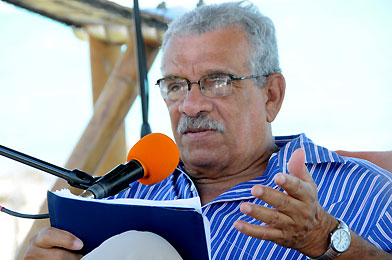
Story Created: Apr 30, 2011 at 11:54 PM ECT
Story Updated: Apr 30, 2011 at 11:54 PM ECT
Nobel Laureate Derek Walcott takes 2011 OCM Bocas Prize for Caribbean Literature.
White Egrets, his collection of poetry that has already won the TS Eliot Prize and was judged the winner of the OCM Bocas Prize poetry category, was chosen for the US$10,000 award last night, seeing off competition from the fiction and non-fiction winners.
The judges in their citation commented upon the "seemingly effortless flow of the language and imagery despite the poet's stated premonitions of the loss of poetic power and inspiration…. Walcott is still writing great poetry, lovely cadences, beautiful images".
They considered the book-length poem that is divided into separate poems and is an exploration of bereavement and grief in one's advanced years to be, "a book that tells of a period of life more usually talked at and talked about than heard from or listened to, which makes it a very important work".
White Egrets is Walcott's 14th book of poems. He has also published eight collections of plays and a book of essays. Extracts of the winning collection were featured in two parts in the Express in April.
The poet, who is at work in Europe on a new theatre production, was not present at the award ceremony and his daughter Mrs Elizabeth Walcott-Hackshaw, who is also a writer, accepted the OCM Bocas Prize cheque and trophy on his behalf. Tiphanie Yanique, whose debut novel, How To Escape From a Leper Colony, won the Fiction category, is visiting Trinidad for the occasion but Edwidge Danticat, winner of the Non-Fiction category for Create Dangerously: the immigrant artist at work was unable to attend.
The ceremony last night in the Old Fire Station included many of this country's and the region's most accomplished writers. It was one of the highlights of the new annual Bocas Lit Fest that started on Thursday at the National Library in Port of Spain. Readings from the winning books take place today at 4 pm, followed by poetry and music performed by the Freetown Collective and a jazz session by Mike Germain and Destino at 5pm, which bring the four-day Festival to an end.

